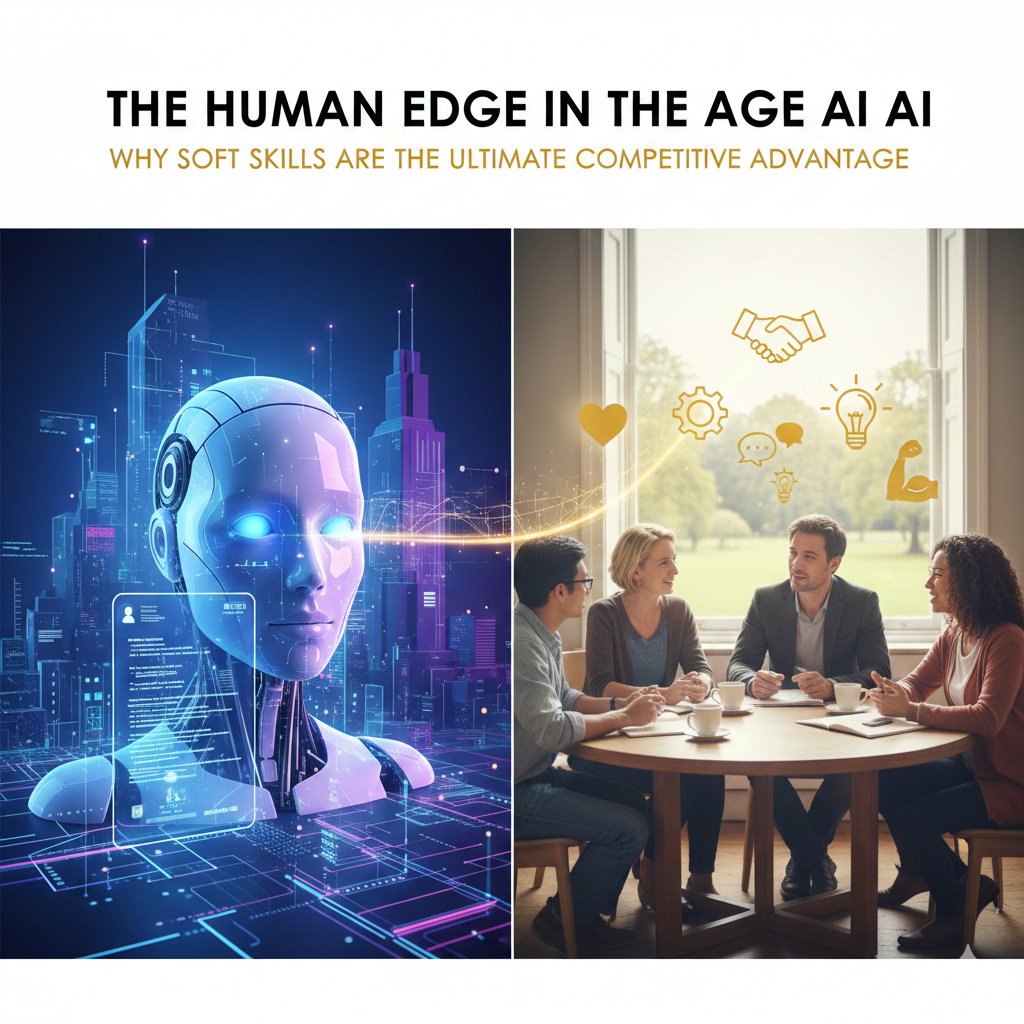
Artificial Intelligence is no longer the future it is the present, its sending emails ,running meetings, its even creating content .In a world increasingly shaped by rapid technological advances, remote work, and global collaboration, the concept of what makes a “winning team” is changing. By 2026, it’s no longer enough for teams to be highly technical; success will depend far more heavily on soft skills. These human-centric abilities like emotional intelligence, adaptability, and effective communication will be the defining edge that sets top-performing teams apart. As machines take over routine tasks, it’s the soft skills that remain uniquely human, enabling teams to innovate, build trust, and navigate complexity.
From automated customer service to AI-powered analytics and decision-making or face-to-face interviews to AI-powered interviews, organizations are rapidly transforming. But amid this disruption, one truth remains unchanged: technology can’t replace human skills and it never will.
In an age where machines can think faster, calculate better, and process more data, soft skills have become the ultimate competitive advantage in your career journey
Why Technical Skills Are No Longer Enough
For years, success in the workplace was tied to hard skills technical knowledge, technical qualifications, and operational expertise.
Today, AI can:
- Write reports
- Analyze data
- Automate workflows
- Even generate creative ideas
So what remains uniquely human?
- Emotional intelligence
- Critical thinking
- Communication
- Adaptability
- Leadership
- Collaboration
These are the skills that define high performers in the AI-driven workplace.
The Rise of Hybrid Work and Human-Centered Leadership
Hybrid and remote work environments are now the norm, not the exception. Teams are more dispersed,communication is more complex and burnout is more common.
In this environment, leaders can no longer manage they must inspire.
Soft skills now determine:
- How effectively leaders connect with their teams
- How conflict is handled
- How feedback is given and received
- How resilient teams become during change
The future of leadership is not about control it’s about connection, clarity, and emotional intelligence.
Soft Skills: The Hidden Driver of Business Performance
Organizations that invest in soft skills experience:
- Higher employee engagement
- Stronger collaboration
- Better decision-making
- Lower turnover rates
- Improved workplace culture
These are not “nice to have” results they are business-critical outcomes because while AI boosts efficiency, soft skills drive sustainability.
The Changing Landscape of Work
Automation and AI Are Shifting the Skill Equation
As artificial intelligence and automation become more capable, many traditional technical tasks will be handled by machines. This means that the value of purely technical expertise may plateau. What machines struggle to replicate human connection, empathy, judgment are exactly the qualities that soft skills cultivate.
Hybrid and Global Teams Are the New Normal
Workforces are more distributed than ever. With remote and hybrid models here to stay, teams are often spread across geographies and cultures. Effective communication, collaboration, and cultural sensitivity are now critical for cohesion and high performance.
Complex Challenges Demand People-Centered Skills
From navigating geopolitical shifts to solving global environmental problems, the challenges of tomorrow are increasingly complex and multifaceted. These problems require creative thinking, negotiation, empathy, and collaboration skills that go beyond technical know-how.
Core Soft Skills That Will Drive Team Success in 2026
- Emotional Intelligence (EQ)
- Self-awareness, empathy, and social skills will be crucial for leaders and teammates alike.
- Emotionally intelligent teams are better at managing conflict, building trust, and maintaining cohesion.
- Communication & Collaboration
- Clear, empathetic communication helps teams avoid misunderstandings.
- Active listening and the ability to resolve conflict constructively are central to collaboration.
- Critical Thinking & Problem-Solving
- Teams need to analyze ambiguous situations, generate creative solutions, and think strategically.
- These skills support innovation and ensure resilient decision-making.
- Adaptability & Resilience
- In volatile environments, teams that adapt quickly and bounce back from setbacks will outperform.
- Resilience helps individuals keep going in uncertainty and change.
- In volatile environments, teams that adapt quickly and bounce back from setbacks will outperform.
- Leadership & Influence
- Leadership is not just for managers; every team member can demonstrate leadership by guiding, motivating, and influencing peers.
- Leadership through soft skills builds trust, nurtures psychological safety, and empowers others.
- Curiosity & Lifelong Learning
- A growth mindset fosters continuous development a must in a rapidly changing world.
- Curious team members ask better questions, push boundaries, and challenge assumptions.
Why Soft Skills Give Teams a Unique Competitive Edge
- The Human Edge Over Machines: As technical tasks become automated, the uniquely human abilities like empathy, creativity, and ethical judgement become what differentiate the best teams.
- Deeper Cohesion, Better Innovation: Teams with strong soft skills build trust faster, share feedback more openly, and create environments where innovation thrives.
- Stronger Customer & Stakeholder Relationships: Empathy and communication translate to better service, deeper customer relationships, and stronger stakeholder trust.
- Leadership in Uncertainty: When disruption is constant, teams that can navigate change supported by emotionally intelligent leadership will adapt and excel.
Evidence from Research & Real-World Trends
- Salary & Career Impact: Research shows that employees with strong soft skills like problem-solving, communication, and teamwork tend to earn more and climb faster, especially in an AI-driven economy.
- Future of Jobs Report: According to observations from labor-market studies, many of the top skills employers will look for include socio-emotional competencies such as complex problem-solving and resilience.
- Academic Insight: Studies in software-engineering and multidisciplinary projects show that soft skills development (e.g. communication, cooperation, self-reflection) strongly correlates with team success.
- Measurement Innovation: New frameworks are emerging to evaluate soft skills more rigorously e.g., using multimodal data (facial expressions, gestures, language) to assess communication and decision-making.
Challenges Teams Face in Developing Soft Skills
- Assessment Difficulties: Unlike technical skills, soft skills are less tangible. Measuring emotional intelligence, adaptability, or communication in a rigorous way is hard.
- Remote Work Barriers: Virtual environments can make it harder to pick up on non-verbal cues, build rapport, or hold meaningful conversations.
- Undervaluing Soft Skills: Many organizations still prioritize hard skills during hiring and training, neglecting soft-skill development.
- Integration with Workflows: Embedding soft-skills training into daily practices (rather than one-off workshops) can be challenging but is necessary for real change.
How Organizations Can Build Soft-Skilled, Winning Teams
- Implement Soft-Skill Training Programs
- Use workshops, coaching, and peer-learning to develop emotional intelligence, resilience, and communication. Book your complimentary consultation with us ; info@seasworldlearningltd.com
- Provide real-life simulations and role plays that mimic real team challenges.
- Embed Soft Skills in Hiring
- Use behavioral interviews, situational judgement tests, or role-based assessments to evaluate soft skills.
- Look for evidence of adaptability, collaboration, and lifelong learning, not just technical credentials.
- Foster a Culture of Psychological Safety and Trust
- Encourage open feedback, active listening, and sharing of ideas without judgment.
- Train leaders to model vulnerability, empathy, and inclusive behavior.
- Promote Cross-Functional and Diverse Teams
- Mix members from different backgrounds, departments, and disciplines to encourage innovation.
- Use collaborative projects to give individuals a chance to exercise leadership, problem-solving, and adaptability.
- Support Continuous Learning
- Encourage a growth mindset by offering mentorship, stretch assignments, and reflection-based practices.
- Reward learning behaviors, not just outcomes celebrate curiosity, experiments, and learning from failure.
In 2026, the teams that win won’t just be the most technically skilled they will be the most human. Soft skills will define success because they enable connection, creativity, and adaptability in a world where machines handle the predictable. Investing in emotional intelligence, communication, leadership, and lifelong learning isn’t optional it’s essential. Organizations that begin building these capabilities now will be the ones that thrive, innovate, and lead in the years ahead.
FAQs
- What exactly are soft skills?
Soft skills are non-technical, interpersonal qualities like empathy, communication, adaptability, and teamwork. - Can soft skills be taught, or are they innate?
Yes, while some people may naturally be more empathetic or curious, soft skills can be developed through training, coaching, and intentional practice. - How do you assess soft skills during hiring?
Use behavioral interviews, simulations, situational judgement tests, and 360° feedback to evaluate how candidates handle real-world interpersonal challenges. - What is the ROI of soft-skills training?
Teams with strong soft skills tend to be more collaborative, creative, and resilient which leads to better performance, lower turnover, and higher innovation.
How do you balance soft skills with technical skills in teams?
Recognize both as critical: hire for soft skills too, design ongoing development programs, and encourage cross-functional collaboration to allow both to flourish.